
2019: Year in Review
With hearts full of gratitude, we take a moment to reflect on our second full year of serving the Church.
With great joy we give thanks to God for our second full year in business; what tremendous blessings it has brought us. We’d like to take the opportunity again to share a few of the highlights and reflect on how God continues to call us to serve his Church in 2020.
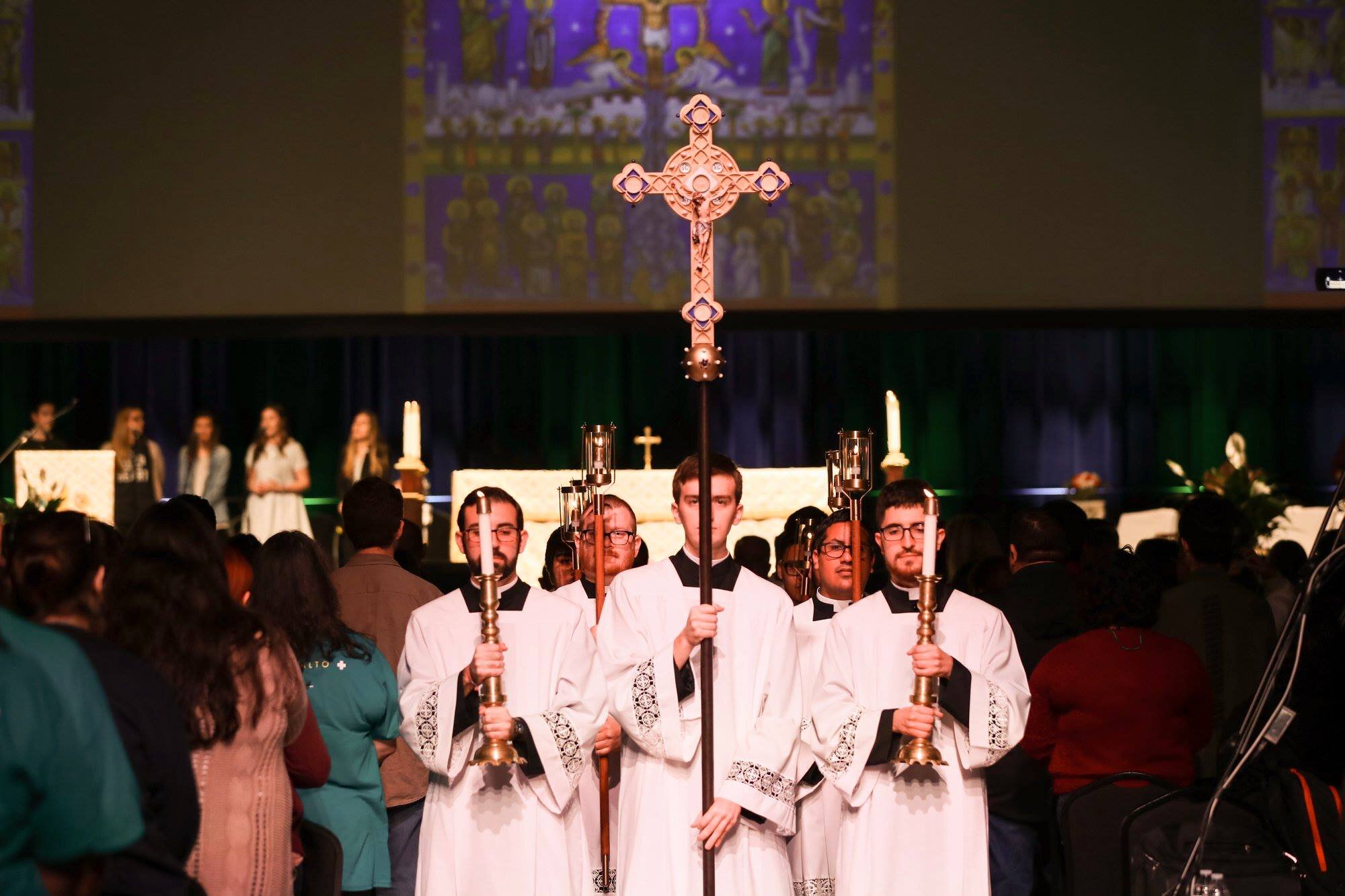
Seminarians from the Diocese of Austin lead the closing procession from the Diocesan Catholic Youth Conference.
In January our team attended the Southwest Liturgical Conference in Houston. It was a joy to see many friends and colleagues, including keynote speaker Dr. Denis McNamara (former Associate Director of the Liturgical Institute, Liturgy Guys Podcast host, and new Executive Director of the Center for Beauty and Culture at Benedictine University). In addition, we got to spend time with Albl Oberammergau and were introduced to Canning Liturgical Arts, both of whom have been collaborating with us on several projects. Shortly thereafter, Michael attended the Diocesan Catholic Youth Conference for the Diocese of Austin in Waco to assist coordinating liturgy and environment, a role with which has been involved since 2013. Each year the conference sees new and exciting improvements to the beauty of its liturgies to make them more engaging to the almost 3,000 high school students and adult youth ministers and volunteers in attendance.
During the late winter and early spring, Studio io was quietly involved with planning a new Catholic high school in West Texas. Workshops were held on the Baylor learning labs research campus in Waco in April, and in May, Holy Cross Catholic High School was officially announced for a fall 2019 launch. We have been assisting Huckabee, Inc. with many planning considerations for integrating prayer and worship into daily life on campus, including school Masses in multipurpose space and a small reservation chapel in phase one, and planning a permanent 450-seat chapel for a future phase for weekly school Masses and daily adoration. We were also able to assist St. Joseph in Marlin, TX with a modest interior repainting scheme that provides quite an improvement.

Michael with parents Joe and Earline at University of St. Mary of the Lake in Mundelein IL
In April, Michael had the pleasure of joining his friends Chris Duffell and Rafael Morales on the Beauty Ever New podcast to discuss Sacred Architecture, and in May attended his Master of Arts in Liturgy commencement with the Liturgical Institute at the University of St. Mary of the Lake in Mundelein IL, marking the completion of a 5-year journey that began in 2014. His thesis, Restored in Christ, proposes a comprehensive framework for mystagogical catechesis building upon Benedict XVI’s Sacramentum Caritatis.

The new Marian grotto at St. Mary’s Catholic Center in College Station, TX
Appropriately in the month of Mary St. Mary’s Catholic Center celebrated completion of a new courtyard with the installation of a new 6-foot marble statue of Our Lady of Grace and custom carved limestone base as its focal point just outside the Hannigan adoration chapel. The courtyard is based on the previous layout, with some improvements for proper drainage and an expanded area for prayer and reflection around the grotto.

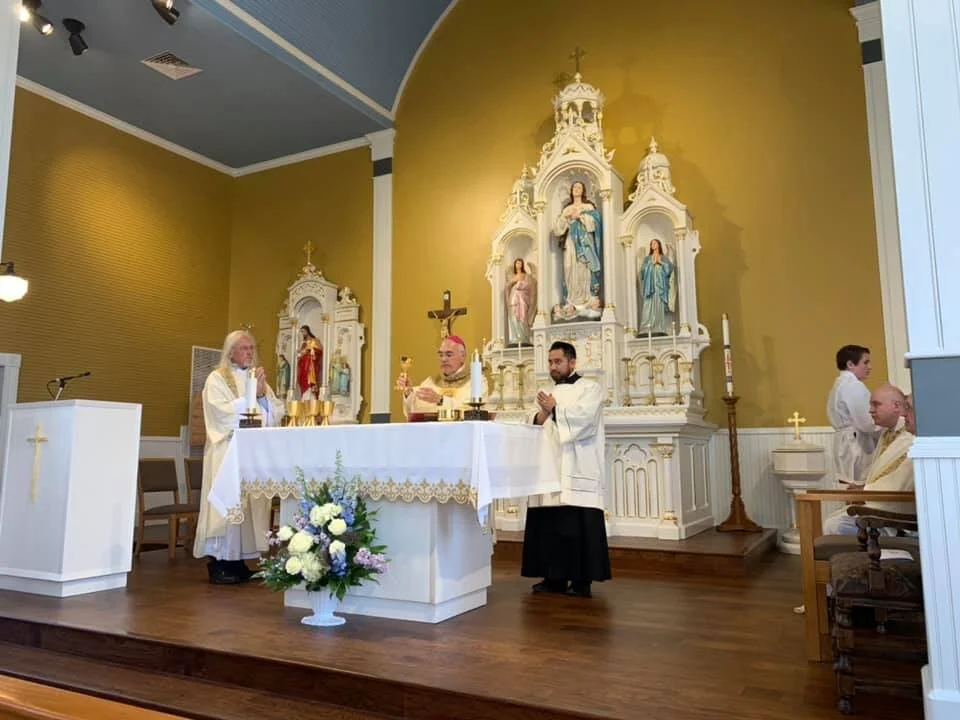
Bishop Joe Vásquez dedicates the new St. Paul Chapel in Smithville, TX on June 5, 2019.

Katie Torvinen (right) and her family at the Reno Rodeo in Nevada.

Michael and Lauren Tamara were married at the Cathedral Basilica of the Sacred Heart in Newark, NJ

Michael and Hannah with Brother Basil at St. Meinrad
The summer was a busy one for the team. At the end of May, Michael traveled to North Carolina to present a two-phase renovation project to Holy Family in Hillsborough, the second stage of which involves an interior church renovation that should move forward this coming summer. June 5 marked the dedication of the St. Paul Chapel in Smithville, TX, and June and July offered opportunities for interviews with Red-C Catholic Radio in College Station, TX. Michael also enrolled in a dual-degree Master of Arts in Sacred Arts and Master of Theological Studies from Pontifex University.
Team members Katie Torvinen and Mike Tamara both moved over the summer. Katie left her home in eastern Florida in May to spend some time with family and the rodeo in Nevada in June, settling into her new home in Denver, CO in July. Mike and Lauren Tamara married in June and moved to Caldwell, New Jersey. The two celebrated a beautiful liturgy in the extraordinary form at the Cathedral Basilica of the Sacred Heart in Newark, NJ with family and friends. Later in July, Michael and Mike met on campus at Mundelein for the Liturgical Institute’s Transfigured young adult liturgy conference, and the team us currently enrolled in several of the school’s new online liturgy courses. Additionally, Studio io began working with the John Paul II Newman Center at UIC on initial concepts for chapel renovations.
In August, Michael and girlfriend Hannah traveled to St. Meinrad Archabbey in Indiana, where good friend and fellow Liturgical Institute alum Christian became Brother Basil, making a profession of simple vows. Also in August, construction began in Fort Wort, TX at WholeLife Authentic Care Clinic, and currently the chapel is framed and awaiting final approval to begin its finish-out this spring. Our friends at New Jerusalem Studios have been commissioned for a liturgical mural on the main wall. Katie attended a symposium in on the theology of sacred architecture lead by Dr. Denis McNamara at St. Mark's in Denver and is working to establish great relationships with clergy and lay professionals devoted to beauty.
In September, Michael presented on Liturgy and Sacred Architecture to young adults at St. Thomas Aquinas Catholic Church in Dallas, and to a general parish audience at St. Joseph Catholic Church in Rice Lake, Wisconsin, where Studio io is assisting with planning beautification concepts. Later that month, Michael and Mike Tamara traveled to Providence, Rhode Island for the Society for Catholic Liturgy’s annual conference, held at the Cathedral of Saints Peter and Paul and at Providence College. At the end of September, Studio io began working with BCDM Architects in Omaha on the new church for St. Martin of Tours in Forney, TX, a project which began in a conceptual state in the fall of 2018 and is now moving forward after a successful capital campaign.
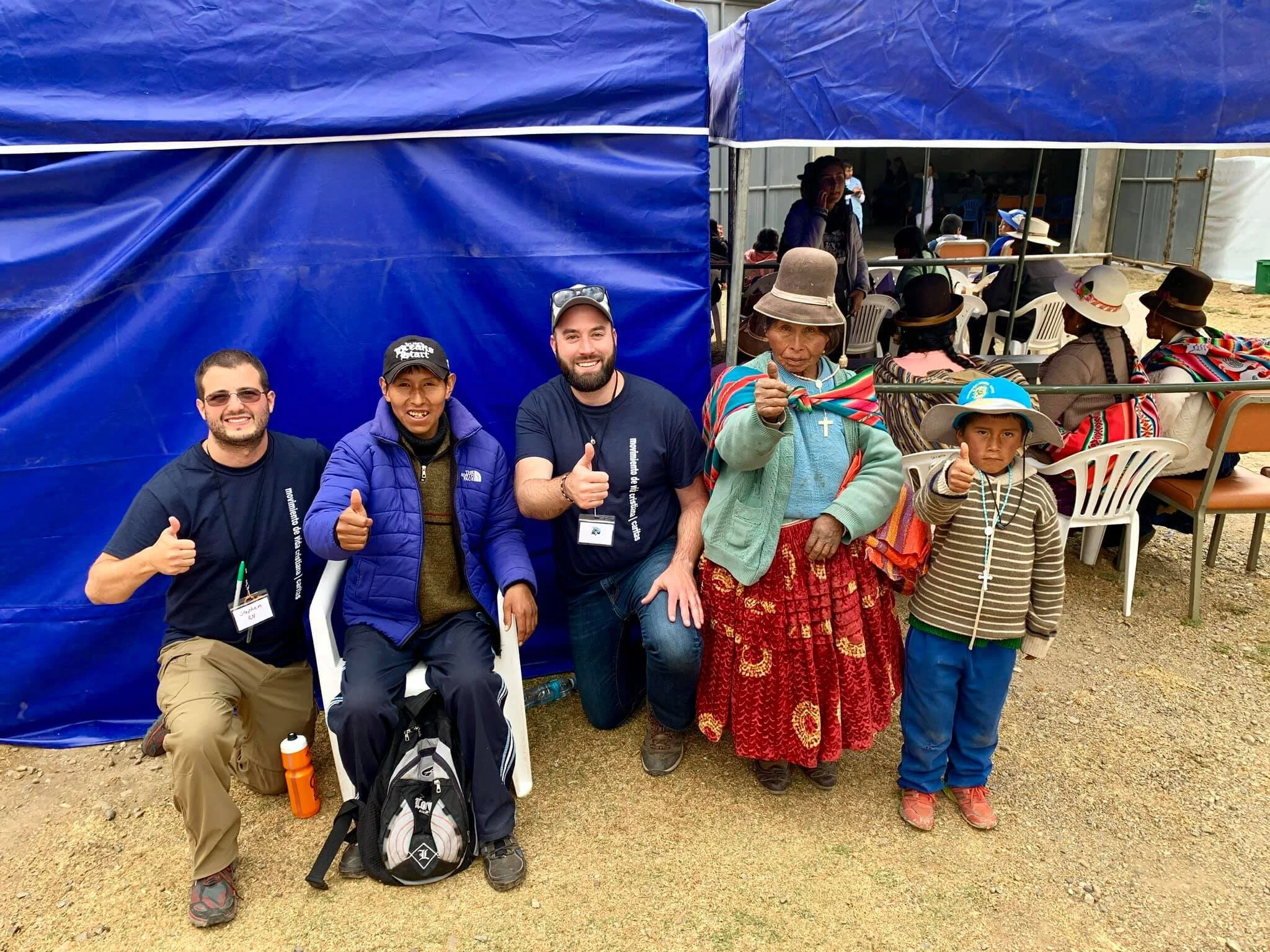
Michael and friend Stephen with regular clinic attendees
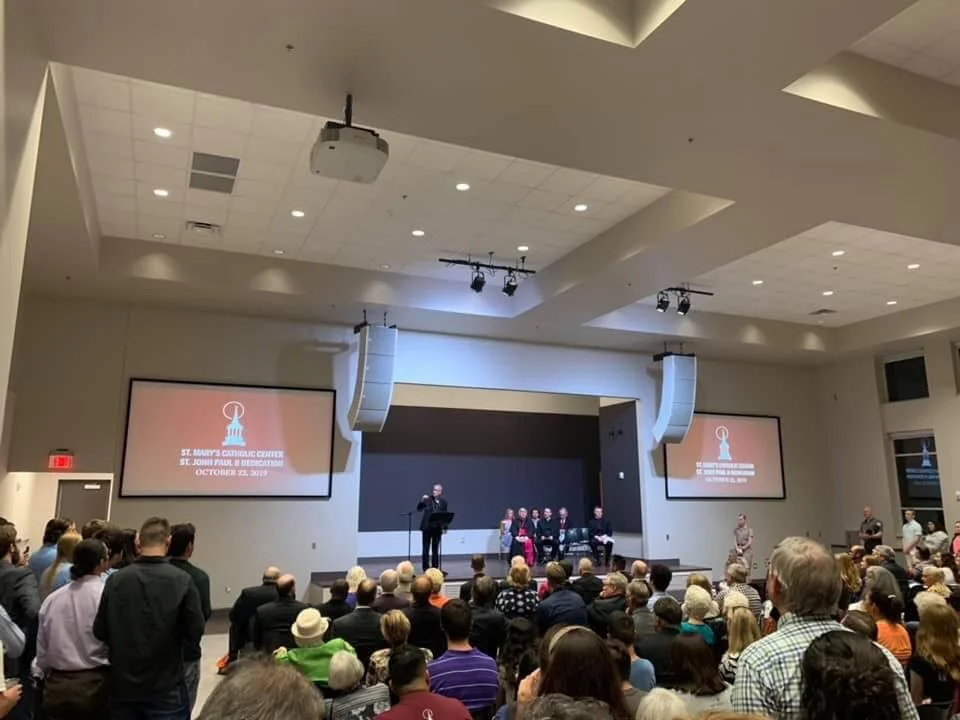
Bishop David Konderla joins Bishop Joe Vásquez to deliver remarks at the dedication of a new building for his former parish, St. Mary’s Catholic Center
In October, Michael had the wonderful opportunity to attend a Catholic Medical Mission to Ayaviri, Peru. The team included volunteers from Colorado, Texas, other states in the US, Colombia, and Lima, Peru, working closely with Bishop Kay Martin Schmalhausen, diocesan priests and religious brothers and sisters, and Caritas. The mission estimates serving some 1,200 people who otherwise have no means of preventive or urgent medical care.

Michael joins Adam Brill and Dom Alcuin Reid for the Engage the Mass Conference at St. Thomas Aquinas
On October 22, the Bishop Joe Vázquez was joined by Bishop David Konderla of Tulsa to dedicate the new John Paul II Student Center Addition at St. Mary’s Catholic Center in College Station (completed with Jackson Galloway FGM), where Bishop Konderla was formerly pastor. The event was preceded by a Mass of Thanksgiving in a packed church, and included appearances by Reveille and members of the Fightin’ Texas Aggie band. Longtime benefactor and friend of St. Mary’s Ralph Schmidt gave a beautiful keynote reflection on the role of St. Mary’s in his own faith life.
The fall months involved several presentations. Wrapping up a busy month of October, Michael led a new youth minister training workshop for the Diocese of Austin, focusing on prayer and worship and looking at the role that beauty and tradition play in the work of evangelization and transformation of the culture. He also was featured speaking on these topics in regard to the firm’s work at St. Martin of Tours on Guadalupe Catholic Radio in the Dallas area in early November. Later in the month, he joined fellow Liturgical Institute alum Adam Brill, St. Mary’s Catholic Center parochial vicar Fr. Greg Gerhart, and renowned liturgical scholar Dom Alcuin Reid for the Engage the Mass liturgy conference at St. Thomas Aquinas in College Station. Dom Reid is currently raising funds for the purchase and improvement of a medieval monastery in France for his community, Monastère Saint-Benoît. Michael’s talk, Beauty and the Sacramental Encounter, painted a picture for the importance of the Church’s role engaging the senses in worship.
In November, the team met in Austin and traveled together to Edinburg, TX to present to St. Joseph Catholic Church on liturgy and sacred architecture and to give a sneak peak into the in-progress design concepts for a new church. The trip allowed for Michael, Katie, and Mike to be joined by Elsa Kosegarten Stubblefield, who is assisting with St. Joseph, and the team made visits to two of Texas’ three basilicas: the Basilica of the Little Flower in San Antonio, and the Basilica of Our Lady of San Juan del Valle.

Church of the Visitation fire in Westlphalia, TX July 29
Late in the fall, we were given a wonderful opportunity to take on a difficult project. We were ecstatic to be invited by the Diocese of Austin to join K4 Construction for the design and construction of a new Church of the Visitation in Westphalia, TX, in response to the tragic July 29 fire that completely consumed the 125-year old wooden structure only three months after the shocking Notre Dame fire in France and was reported in news across the country. While the parish holds Masses in the parish hall, the project is making good progress and spirits are high. The committee received a presentation on sacred liturgy and architecture, including the role of tradition and beauty, shortly before Christmas.


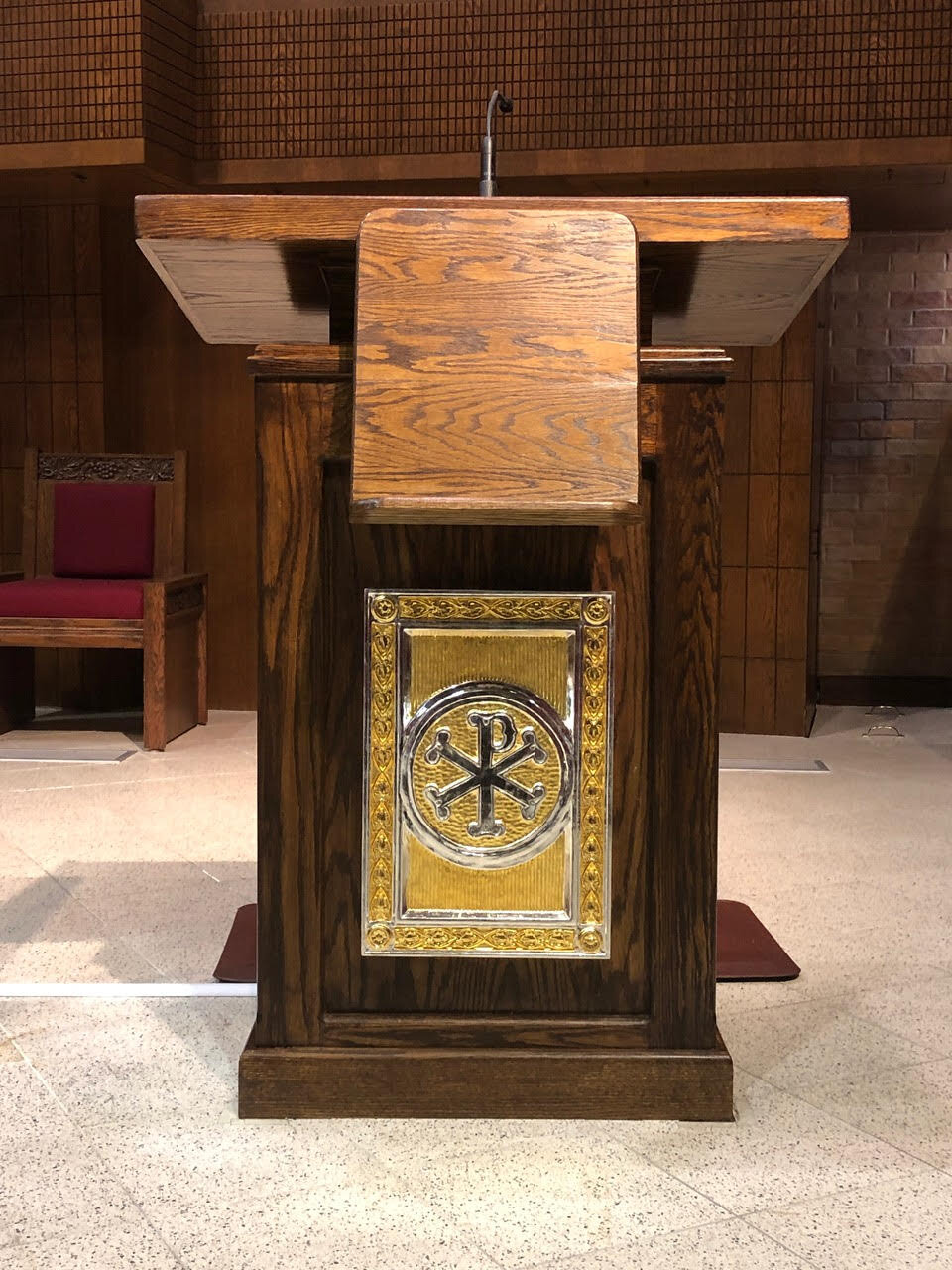

Also in November, our friends at Albl Oberammergau completed gorgeous new gilded wood carvings for the altar (Agnus Dei) and ambo (Chi Rho) at Holy Family Catholic Church in Copperas Cove, TX (right). Two new stained glass windows featuring the Holy Family and St. Michael the Archangel as patron of the armed forces (Fort Hood is nearby) will be provided by Foster Stained Glass, who will also be commissioned to replace the historic windows lost in the Westphalia fire.
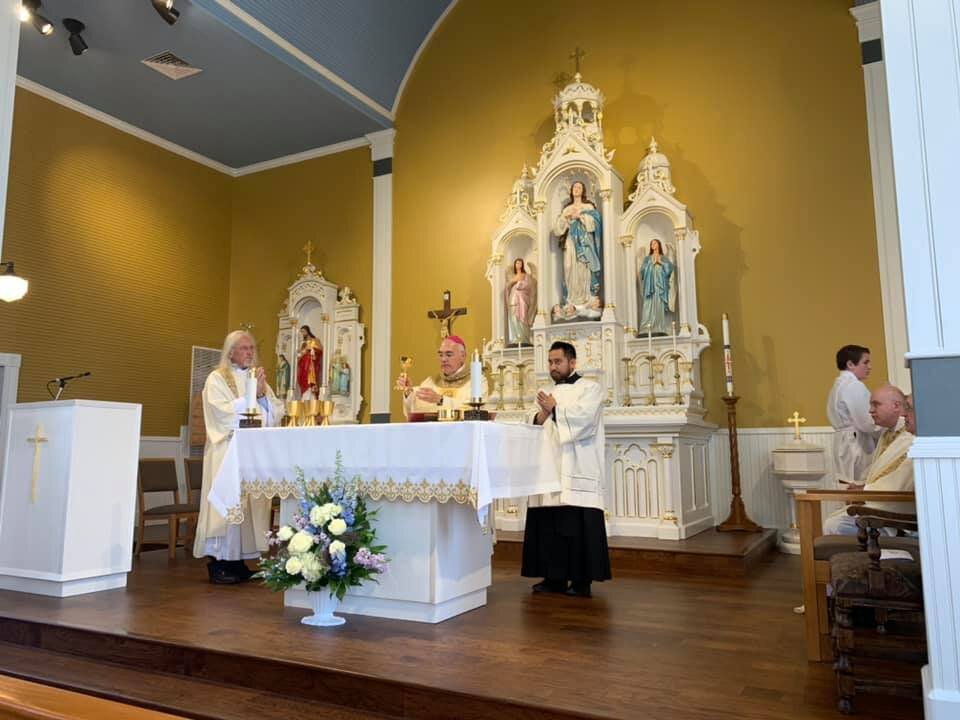
December 14 saw the third and final dedication of the year, at the newly expanded and restored St. Mary of the Assumption in String Prairie, a nearly 120-year old wooden structure and a project began by Jackson Galloway FGM Architects in 2014. The seating expanded dramatically along with more restrooms and rebuilt sacristies. The choir loft was also rebuilt to better accommodate additional seating. A simple original paint scheme was uncovered and restored along with carved gothic high altar and side altars, and the 80-foot bell tower & steeple were restored after almost a century of being capped much lower after it was lost in a storm. Perhaps the most striking interior aspect of the project is the flooring; the carpet was removed to expose the longleaf pine floors, which were matched with salvaged wood from a historic barn and refinished.
Christmastime saw the announcement of moving forward on two exciting 1950s gothic church interior renovations: St. Mary of the Assumption in Taylor, TX and Holy Rosary in Rosenberg. Both projects are being planned with the assistance of our friends at Canning Liturgical Arts.
We have many exciting things emerging already for 2020 and are eager to see what will continue to take shape. Please pray for us that we may continue to be formed and transformed, remaining docile to the will of the Father and the work of the Holy Spirit in the Body of Christ. Thank you also for your prayers for all of our clients who have undertaken the difficult work of renewal by investing in beauty and formation, that it may enrich all sacramental life and ministerial work, and inspire each person who is affected by the work we do to be a faithful disciple and servant of Jesus Christ.

On Sacred Silence
Most Catholics encounter regular challenges to the deep reflection the Church encourages before and throughout the liturgy.
by Michael Raia
Most Catholics encounter regular challenges to the deep reflection the Church encourages before and throughout the liturgy. After all, the earthly liturgy is both a heavenly and human act. Among the possible culprits are various distractions among the assembly – an entirely expected and important one to overcome – the musicians and other liturgical ministers, and many times a celebrant who omits this critical element. Central to the active participation urged leading up to Vatican II by the Liturgical Movement and certainly thereafter, sacred silence is paramount for allowing the exterior participation (postures, gestures, responses, singing) to develop the deeper interior participation of the heart and mind. Whether in the interest of time or a lack of awareness of this essential component, the exclusion of sacred silence from the liturgy can have profound results, particularly in a society that is starved for it. Put another way, one of the key reasons that many Catholics do not experience the transforming power of the liturgy is that there is not enough in the way of sacred silence.
Consider these two sections of the General Instruction of the Roman Missal:
45. Sacred silence also, as part of the celebration, is to be observed at the designated times. Its nature, however, depends on the moment when it occurs in the different parts of the celebration. For in the Penitential Act and again after the invitation to pray, individuals recollect themselves; whereas after a reading or after the Homily, all meditate briefly on what they have heard; then after Communion, they praise God in their hearts and pray to him.
Even before the celebration itself, it is a praiseworthy practice for silence to be observed in the church, in the sacristy, in the vesting room, and in adjacent areas, so that all may dispose themselves to carry out the sacred celebration in a devout and fitting manner.
…
56. The Liturgy of the Word is to be celebrated in such a way as to favor meditation, and so any kind of haste such as hinders recollection is clearly to be avoided. In the course of it, brief periods of silence are also appropriate, accommodated to the assembled congregation; by means of these, under the action of the Holy Spirit, the Word of God may be grasped by the heart and a response through prayer may be prepared. It may be appropriate to observe such periods of silence, for example, before the Liturgy of the Word itself begins, after the First and Second Reading, and lastly at the conclusion of the Homily.
Benedict XVI also addressed this in The Spirit of the Liturgy:
We are realizing more and more clearly that silence is part of the liturgy. We respond, by singing and praying, to the God who addresses us, by the greater mystery, surpassing all words, summons us to silence. It must, of course, be a silence with content, not just the absence of speech and action. We should expect the liturgy to give us a positive stillness that will restore us. Such stillness will not be just a pause, in which a thousand thoughts and desires assault us, but a time of recollection, giving us an inward peace, allowing us to draw breath and rediscover the one thing necessary, which we have forgotten. That is why silence cannot be simply “made"“, organized as if it were one activity among many. It is no accident that on all sides people are seeking techniques of meditation, a spirituality for emptying the mind. One of man’s deepest needs is making its presence felt, a need that is manifestly not being met in our present form of liturgy.
A few key points to keep in mind as context and backdrop to these excerpts:
1) Sacred silence is not merely a void of external liturgical action. It is a deliberate time to go deeper. The priest acting as head of the body must model this action and lead the assembly into it as well. As dynamic and engaging as the music, homily, and other aspects of the liturgy may be, if a priest cannot himself pray in silence at these times of the Mass, he cannot reasonably expect his assembly to do so, and they will continue to struggle to realize the vision of the Council for the renewal of the liturgy.
2) As sensate beings, we know that our surroundings play a central role in our attitudes and dispositions. The church building and all of the material signs that play a role in the liturgy affect our ability to properly engage in liturgy, which is precisely why the Church gives them such an exalted role in the practice of the faith (See the Order of Dedication of a Church and an Altar, for example). A beautiful church can contribute to fostering a rich and fruitful sacred silence that draws the faithful more deeply into the Paschal mystery. A poorly designed or badly renovated church will fail to do so because it is less than sacramental and transcendent, focusing only on the here and now and not pointing to heaven. This causes the members of the body to be unable to engage at the deeper level of active or actual participation (not just going through the motions), waiting for the next moment of “religious entertainment” that Benedict cautions is not at all what the Church has in mind for the faithful to respond to the universal call to holiness.
This can certainly be a challenge with the Mass schedules that many priests are required to keep, with tidying up of pews and loading and unloading parking lots. But this paramount element of sacred silence is not dispensable in the slightest. Even 10 deliberate seconds of silence and stillness in the liturgy are incredibly powerful, especially when a priest teaches his parish how to really pray. To our dear priests, thank you for your lives of service. Please be mindful of the importance of this component of the liturgy in bringing us all to a greater disposition to receive the grace of the sacraments and to be transformed in holiness and configured to the will of God. Please invest and likewise encourage your faithful to invest in this aspect of the liturgy that is crucial for developing the spirituality for the interior dimension of active participation that is the right and duty of all the baptized.

2018: Year in Review
This year has been a source of tremendous blessing. Here are a few highlights.
by Michael Raia
This year has been a source of tremendous blessing. As the first official year of business for Studio io, 2018 provided some wonderful opportunities for professional and personal growth. Stepping away from a wonderful position with a family of longtime co-workers to step out in faith in pursuit of a different calling was difficult, but the Lord provided a great deal of affirmation and grace, particularly through the kindness and support of my former bosses and the clients with whom I have been able to continue to work to complete active projects on the other side of the transition. In thanksgiving for God’s abundant generosity, I would like to recap a few other highlights for which I am particularly grateful.


The year began with the exciting completion of conceptual design of a Parish Evangelization Center and chapel for St. Eugene in Oklahoma City with Jackson Galloway Architects (JGA). Shortly thereafter, one of the first independent projects Studio io was able to work on was Sons of Thunder, a priest retreat center chapel. While it was put on hold and did not come to fruition this year, the opportunity to do that work was a great source of encouragement. Shortly thereafter, I had the opportunity to work with St. Vincent Pallotti in Abilene, TX (top left) on the conceptual design for a church renovation and to assist St. Ignatius Martyr in Austin with planning the installation of stained glass windows and renovating confessionals. Another tremendously enjoyable project emerged from a very dated youth room in need of renovation. St. Elizabeth Ann Seton in Houston endeavored to transform the room into The Well (middle left), a comfortable and inviting parish lounge intended to provide a place for inter-generational use for ministry.

Studio io also been able to provide pro bono consulting work for several clients, including a chapel design study with the deacon class at St. Mary’s Seminary in Houston, an ongoing sustainable earthen block hermitage planning effort for the Gospel of Life Disciples in Oklahoma, and some work for the Diocese of Austin: planning a model for a prototype church to be building on three parish campuses, two of which are being relocated to provide adequate space to accommodate rapid growth. Additional pro bono consulting work with the University Catholic Center included coordinating a consultant to design a full sound system replacement, designing exterior Mass times signage, and doing some initial planning for sacred art on the exterior of the building and making an introduction to my very talented friend Baker Galloway, who recently completed a beautiful installation of the icon he was commissioned to paint (bottom left). The image of Christ was installed in vinyl film over a central window of the building facing the iconic UT tower and the bustling south lawn and view corridor in the center of the university campus.
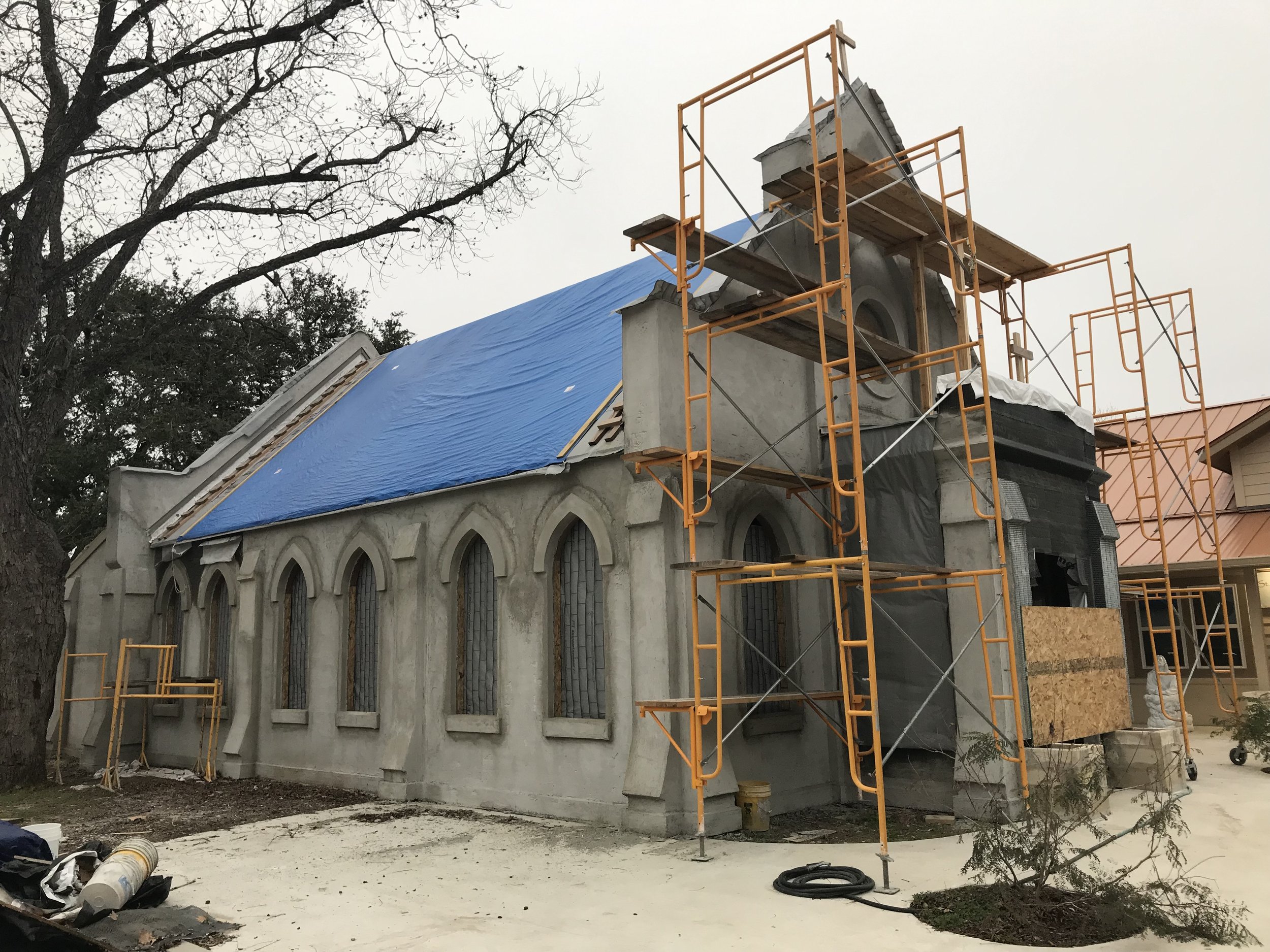
Amid several projects and consulting efforts with Studio io clients, construction administration of other projects designed with JGA began. A new chapel for St. Paul in Smithville, TX (top right) is well on its way, followed by a delayed start to the John Paul II Student Center Addition at St. Mary’s Catholic Center in College Station, TX and an exciting historic restoration and addition to the 127-year old St. Mary of the Assumption in String Prairie, TX (bottom right).
Conceptual design of an exciting new Evangelization Center at Sts. Peter & Paul in New Braunfels, TX with JGA is now complete, and apart from the Student Center expansion we are also assisting St. Mary’s with a new Our Lady of Grace shrine, bronze relief of John Paul II, and conceptual budgeting and preliminary sacred art design for a the new church.


Late in the summer, Studio io began working with Most Holy Trinity in Angleton, TX to consider options for adding a youth center and classrooms. St. Martin of Tours in Forney, TX partnered with Studio io to undertake planning of an ambitious parish renewal campaign with a refined master plan and conceptual design for a beautiful new traditional Texas-vernacular gothic revival church as its centerpiece. This project provided a wonderful opportunity to collaborate with Studio io team members Katie Torvinen and Mike Tamara, who are taking on expanded roles with the firm in 2019. Towards the end of the year, Studio io was engaged to begin planning work with several new clients on exciting church renovation projects. We look forward to what lies ahead for these parishes in the coming months.
We are blessed to see what God is doing in his Church, and we are eager to continue encouraging the comprehensive renewal that is so badly needed. We greatly appreciate your prayers. To learn more about Studio io, please visit our blog, read about our values, and see more of our work.
S
Adoration & Exposition: How Each Serves the Liturgy
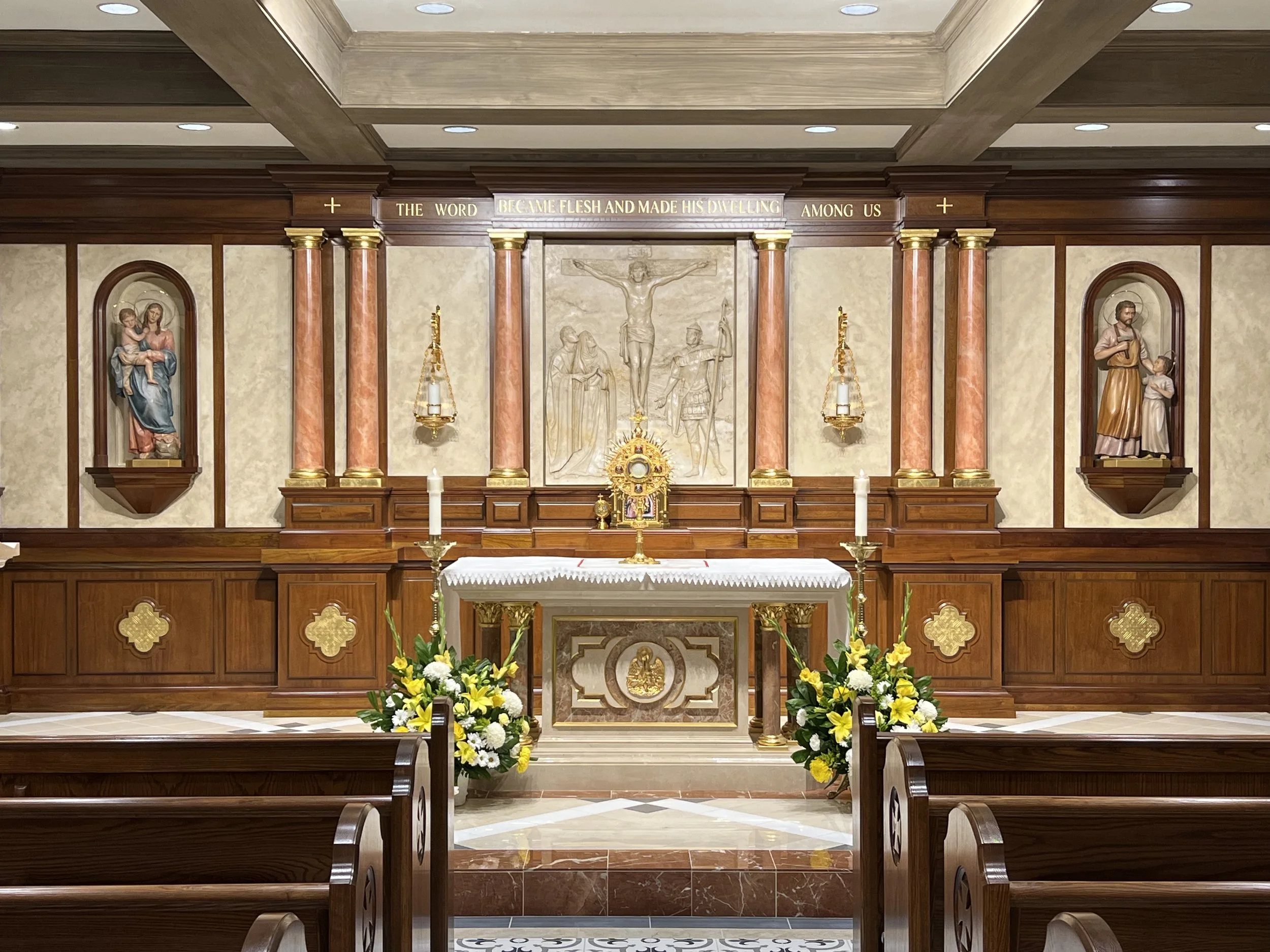
The practice of Eucharistic worship of the Blessed Sacrament is intended to lead the faithful into a deeper participation in the paschal mystery of Christ in the liturgy.
by Michael Raia
“The practice of Eucharistic worship of the Blessed Sacrament…is intended to lead the faithful into a deeper participation in the paschal mystery of Christ in the liturgy!”
Multiple Church documents make clear the role of eucharistic worship (what is frequently referred to as “the cult of eucharistic worship”) and strongly encourage the practice. While in popular practice the purpose has been understood, somewhat simplistically, as spending more time with Jesus, this is only part of the picture. Not only is the liturgical theology that understands the respective roles of the devotional practice of eucharistic adoration and the Rite of Exposition beautiful in its own rite, but the distinction is necessary understand how each serves the liturgy. Both in private prayer and corporate liturgy, eucharistic worship leads us into more authentic participation in the Mass and sacraments – the primary place of personal encounter with Christ. The normative book governing the disciplines of these practices, Holy Communion and Worship of the Eucharist Outside Mass (HCWEOM), states, “The celebration of the eucharist in the sacrifice of the Mass is the true origin and purpose of the worship shown to the eucharist outside Mass.”
For many years the Church has been affirming and asserting the true presence of Christ in the eucharist, and in popular practice the proliferation of adoration chapels in churches has been of great assistance in addressing this need. The idea of spending time before the Blessed Sacrament to grow in love of Christ and to recognize more deeply with the eyes of faith his sacramental presence in the eucharistic host is well founded. However, it is not an end unto itself. From the nascent development of the practice of eucharistic worship of the Blessed Sacrament reserved to provide communion to the sick, the Church has understood its purpose to be more than merely leading the faithful into a deeper relationship with Christ – it is intended to lead the faithful into a deeper participation in the paschal mystery of Christ in the liturgy! Again, from from HCWEOM: “The principal reason for reserving the Sacrament after Mass is to unite, through sacramental communion, the faithful unable to participate in the Mass, especially the sick and the aged, with Christ and the offering of his sacrifice.”
“If adoration and Exposition are not leading us into a more reverent and zealous participation in the Mass and reception of Holy Communion as the visible sign of that participation, they are failing to serve their purpose.”
There are two forms of worship that the Church upholds as integral to Christian spirituality: liturgy which is public, and popular piety or devotion, which is private – even when prayed together among multiple individuals. An example would be the rosary prayed by multiple people; it remains devotion and is considered private prayer because it is not liturgy even if 100 or 1,000 people pray it together. The practice of adoration – that is spending time adoring the Blessed Sacrament in the tabernacle of a church or chapel – is rightly understood to refer to devotional worship and as such, is, strictly speaking, optional (see the Directory on Popular Piety for more on this). That said, multiple legislative documents strongly urge the reservation of the Blessed Sacrament in the church, making daily adoration (not necessarily Exposition) available to the faithful. The Church encourages keeping churches and chapels accessible whenever possible to allow the faithful to develop a eucharistic spirituality. The Rite of Exposition, however, is a liturgy of the Church, and as such is public in nature; it leads from and flows to the Mass and the sacraments, which are properly understood to be participation in the paschal mystery of Christ. Holy Communion and Worship of the Eucharist Outside Mass several other interrelated documents linked below, while providing for the possibility of extended periods of Exposition, make clear that this is a rite, and as such is distinct from the general practice of adoration. It can safely be assumed that if Exposition is observed more similarly to how adoration is intended – that is, apart from the rite, something of the Church’s intention is lost. If the faithful who frequently or even occasionally attend adoration where the Blessed Sacrament is exposed in the monstrance but never witness or partake in any semblance of the rite, an important aspect of liturgical worship has been appropriated for individual devotion.
So why split hairs over this issue, and why does the Church even have a different theology behind each practice? Well if communion with Christ is the end goal, the Church professes that this does not just happen in private prayer; it happens sacramentally in the liturgy. In other words, if eucharistic worship outside of Mass is not leading us into a deeper relationship with Christ in the liturgy, it is failing to serve its purpose. Both adoration and Exposition serve this purpose: adoration does so in a private devotional context, and Exposition in one that is public, or corporate, and liturgical. These two parts reflect the beautiful understanding of the vertical (individual) and horizontal (communal) dimensions of our eucharistic faith, and the two parts of spirituality that are essential for every Christian. Most of us have been guilt of over-emphasizing one over the other at times, and I would propose that in America the tendency to emphasize one’s individual devotion over and sometimes against the liturgical action of the corporate body is frequently a problem.
The distinction is critical to allowing both forms to fulfill their purpose: leading the faithful back into vibrant worship in the Mass, where we actually encounter and participate in that which we merely recall through adoration and Exposition – the saving mystery of Christ made present at the altar. It is the joining of our hearts and our living sacrifice of praise that God wants, and every moment of eucharistic worship better prepares and disposes us to make this great act at our next Mass. And furthermore, the union of joining our sacrifice of praise to the saving act of Christ at the altar is sacramentalized – made visible, tangible, and present, in the reception of Holy Communion. Put another way, if adoration and Exposition are not leading us into a more reverent and zealous participation in the Holy Sacrifice of the Mass and reception of Holy Communion as the visible sign of that participation, they are failing to serve their purpose.
“Exposition of the Blessed Sacrament is a public rite, not a private devotion like adoration. Each serves its purpose to foster a greater love of him who is truly present.”
Practically speaking, how does this take shape in parish life or ministry, and what revisions to practice could be considered? A simple suggestion is cultivating an awareness of which act is which and encouraging the faithful to act accordingly. If a church or chapel with a tabernacle is available, eucharistic worship can take place in the form of adoration (not exposing the Blessed Sacrament in a monstrance), which is private devotion. If Exposition with a monstrance is desired, at least according to the current rite (see note below) it is public liturgy and should follow the Rite of Exposition or one of the adaptations provided. I have recommended to several parishes to consider a greater encouragement of the faithful to use the church tabernacle to adore whenever possible, as encouraged by the documents, and intentionally emphasize the liturgical aspect of the Rite of Exposition. This could mean celebrating the Rite daily, weekly, or monthly, whether for 30-60 minutes immediately after Mass, or even with Exposition in the morning and benediction / reposition in the afternoon, observing the aspect of the rite that suggests the integration of Scripture readings and songs, and even offers the integration of Liturgy of the Hours. One parish I assisted with leading a youth retreat opted to observe devotional time in front of the tabernacle on one night, and the Rite of Exposition the following, illustrating the dynamics of how each of these are intended to be integrated into a liturgical spirituality that better prepares the faithful for the Mass.
To recap: Exposition of the Blessed Sacrament is a public rite, not a private devotion like adoration. Each serves its purpose to foster a greater love of him who is truly present, and to prepare the faithful to more deeply encounter him in the heart of the eucharistic mystery made present at Mass – the place where he principally and calls out to his mystical body and bride the Church to be joined to him and the divine life of the Trinity, for the glory of God and for their growth in holiness.
This article is not intended as – please excuse the unintended pun – a scholarly exposition. To request further resources, please feel free to contact me. I would highly recommend anyone who assists with the planning of eucharistic worship purchase a copy of Holy Communion and Worship of the Eucharist Outside Mass. It is worthy of note that the USCCB is in the process of revising this document, so we might expect to see some clarifications and changes, and at present the potential shifts that it could see are only a guess. Given that the widespread popularity of perpetual adoration is, strictly speaking, not currently addressed in the way it is observed, we might speculate this could be incorporated in some way. However, using the Church’s theology of liturgy and devotion, we can place the other aspects of this resource within the context of the larger theology to understand how the Church intends these elements to work together.
Resources for further study:
Eucharisticum Mysterium (1967)
Redemptionis Sacramentum (2004)
Sacramentum Caritatis (2007)

Catholic Church Design: Form and Function
When it comes to church design, how exactly should we understand ‘functional’? As Catholics, we believe that the material world is sacramental and deeply symbolic.
by Michael Raia
Many folks with an average knowledge of architecture are familiar with a handful of names and concepts related to twentieth-century Modernism and it's influence: Le Corbusier, Frank Lloyd Wright, Frank Gehry, and possibly the often repeated axiom "form follows function." Rather than debate the merits of this concept and the implications it has for all buildings, I propose reconsidering the role of a church building as fulfilling two types of function: that of utility and that of the sacred.
As Catholics, we believe that the material world is sacramental and deeply symbolic; that is to say that everything created can mediate God's presence to us; communicate his divine nature, his plan, and his love. Our built environment can either clarify or confuse this reality. Simply put, this is the job of a church building, and in an even more specific way than other buildings. The purpose of a courthouse is to symbolize law and order in such a way that it encourages and inspires upstanding conduct and virtue. A poorly designed courthouse does little to inspire confidence in the order of the legal system. The purpose of a home is to encourage Christian living in a way that makes families holy and encourages them to be good disciples and missionaries. But a home that discourages community will make this difficult – something we have seen happen to our new neighborhoods as our communities become even more isolated and individualistic. Even our athletic, entertainment, and leisure facilities speak to us about our need for activity and community, and they can encourage these activities in a godly and virtuous, or disordered way.

Detail, Church of the Transfiguration, Philadelphia (Credit: Matthew Christopher, Abandoned America)
When it comes to churches, it is so easy for us to lose sight of the sacred action of liturgy and become solely concerned with the function of utility. There are reasonable and important human concerns: are there enough seats and adequate restrooms? Are the lighting and sound systems setup so that we can we see and hear the liturgy? All of these presuppose the deepest function of a church building that go beyond utility: to aid in our worship and to communicate the divine. It does so in a way that far surpasses the other buildings on a parish campus; all of them provide lit, conditioned space for gathering. The church actually brings heaven to earth, or you could say, transports those present into heaven. It is a foretaste of the glory and perfection that is to come, and it is actively working to bring those things about as we strive toward ongoing conversion and build up the Kingdom of God. The separation between the natural and supernatural is porous in this mystical place where God comes to reside with and within his people. This is why it's not ever adequate to think of the aesthetic and symbolic aspects of a church as optional, dispensable, or even secondary to the strictly utilitarian requirements of a commercial building.
The question of function is ultimately tied to purpose, and to say that a church building's purpose is limited to meeting utilitarian human needs is to overlook the spiritual needs that are met in the liturgy. Why does a church need to have good sound and lighting, enough seats, restrooms, and so on? We have said that it is so that people are able to worship – to join their minds and hearts to that of the priest and Christ to be taken to the right hand of the Father as a foretaste of heavenly eternity, and in so doing to give God glory and be made holy. But we also know that how Catholics worship takes place is through the ritual liturgy that defines the sacraments. God communicates his grace in visible, tangible form. It's not just represented through these efficacious signs, it's actually made present by them!
Churches have the awesome responsibility of transporting us visibly and tangibly to heaven, because that's what happens when we gather to worship in liturgy. As such, a church is a sacramental, an object that points us to the reality contained within and made present by the sacraments. This is a sacred function, and it's why there is a beautiful liturgy specifically for sacred buildings: The Rite of Dedication of a Church and an Altar. Accordingly, it is impossible accurately to think of a church building as strictly 'functional' in the utilitarian sense with which Modernism has defined it. The church is not merely a place of human action, but also and preeminently divine. God acts, and we respond; this is the mystery of salvation: "We love because he first loved us" (1 Jn 4:19).
Header image taken from Louis Bouyer's book Liturgy and Architecture.
For more on the symbolism of the church building, please consider reading the following posts:
A Case for the Christian Temple
Catholic Church Architecture and the Mind of the Church - Part 1
Catholic Church Architecture and the Mind of the Church - Part 2
More Parish Renovation Considerations
Many times an obvious and substantial facilities need is daunting, and can pose a challenge to making progress. While often there is reason to postpone any changes until they can be coordinated and integrated into a comprehensive plan, there are also situations when it might be prudent to consider taking incremental steps towards a larger goal, or even to split a project into phases.
by Michael Raia
Ever sit in a church or parish hall and daydream about renovations? I sure do. But I've chatted with a lot of pastors, parish business administrators, and committee chairs who simply don't know where to start. Many times an obvious and substantial facilities need is daunting, and can pose a challenge to making progress. While often there is reason to postpone any changes until they can be coordinated and integrated into a comprehensive plan, there are also situations when it might be prudent to consider taking incremental steps towards a larger goal, or even to split a project into phases. Here are some considerations for evaluating the circumstances in your parish.

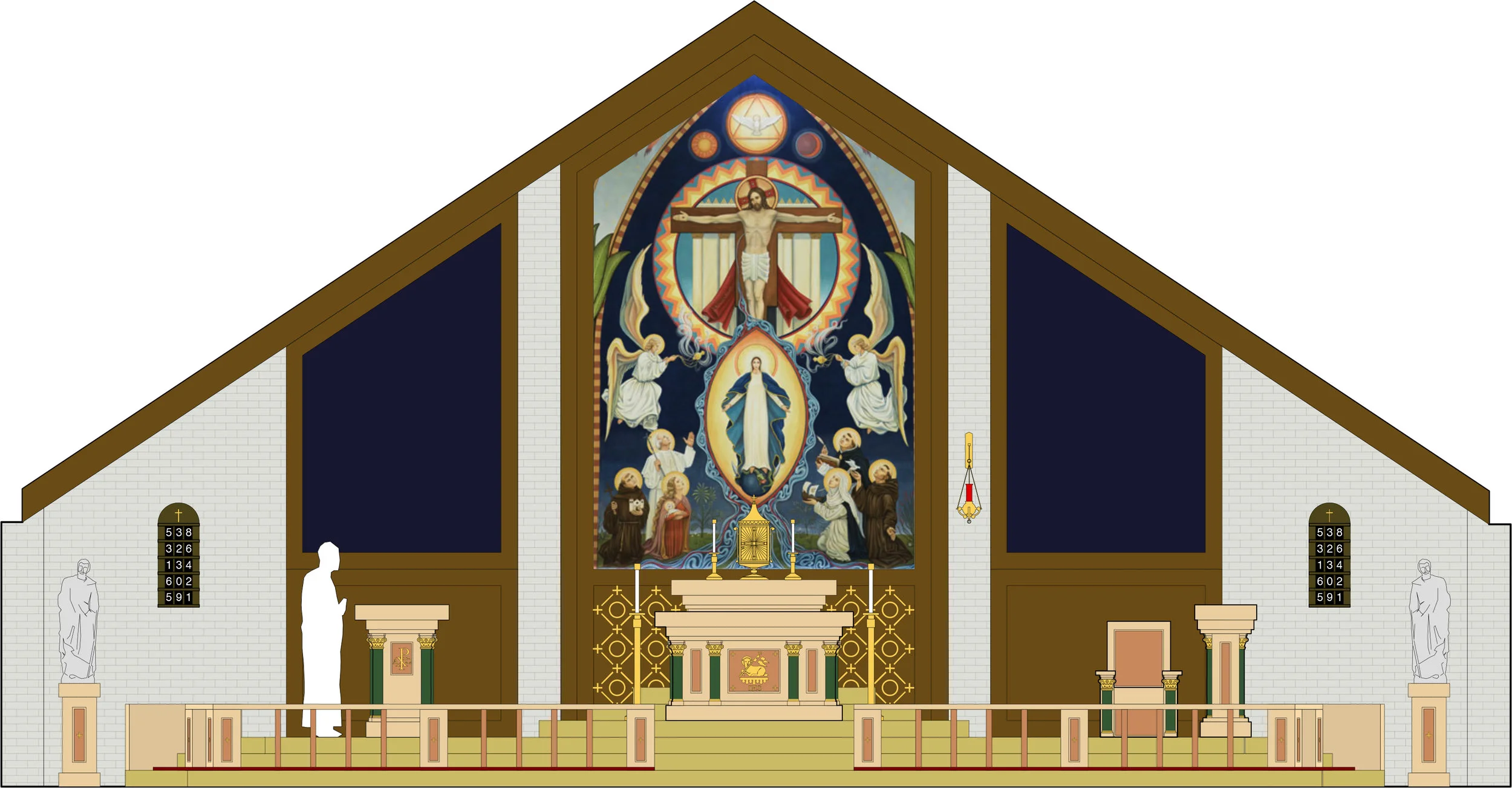
Conceptual proposal for a church renovation in west Texas. Mural courtesy of New Jerusalem Studios.
Project Scope: Size and Content
Are the facilities needing something that is just one or two big items such as flooring or lighting, either within one building, or spread out across multiple buildings? If all in one building, this project may benefit from a comprehensive plan to incorporate all needs. If it's work to take place across multiple buildings, it may make sense to either complete one trade at a time, such as flooring. There may be reason, however, to complete all projects in one building at a time before moving to another building. Key considerations in discerning the best approach include cost and scheduling. Technology is also a big consideration; it may be beneficial to install WiFi, audio-visual systems, building access control and security across multiple buildings in that executing this work in stages can sometimes be costly.
"If there are emotional challenges to overcome in creating buy-in for the parish it may be wise to take the low-hanging fruit first, then build trust and increase giving before proceeding."
If the project is much larger and complex in nature, such as the need to substantially update and beautify the interior of a church or chapel, a comprehensive plan is likely a better route to take whether the project is executed all at once or in phases. For instance, there might be a need to redesign the sanctuary within a church, commission new sacred furnishings and sacred art, or install new pews, flooring, and lighting. It's certainly possible that there is enough momentum and funding behind the project to plan to complete it in one phase. But if there are emotional challenges to overcome in creating buy-in for the parish it may be wise to take the low-hanging fruit first, then build trust and increase giving before proceeding. Many times it is also realistic that items such as stained glass or statues can be planned from the start, but may require additional sponsorship outside of a capital campaign to fully fund.
Preparing for a Larger Project
So what if a parish badly needs functional or aesthetic upgrades, but can't afford any expensive changes yet, or it's just not good timing? For a church or chapel in need of changes, what can be done to beautify the liturgy and encourage a more robust devotional life in the faithful? Some options might include:
- Spend the time and money on good technology. There might be an acoustical problem or sound transmission problem. There are many ways to address this with materials, and with the sound reinforcement systems themselves. In other rooms, even great acoustics will not help a terrible sound system very much. Meeting rooms and parish halls, especially when used for overflow liturgies, may see great use come of installed projectors and screens for presentations. This increases the quality of the regular ministry content, but also saves the staff and volunteers a lot of work.
- Assess affordable upgrades: flooring, lighting, ceiling tiles, painted walls, and seating may be simple ways to improve the aesthetics and usability of facilities and build momentum and trust for a larger project.
- Commission a study and revamp of liturgical ministries. The training and reverence of servers, readers, and extraordinary ministers of Holy Communion all have an impact on the aesthetics of worship and affect how Mass-goers experience worship. This does not need to require any funding.
- Review the sacred music program and study the documents and teachings to better form those in the music ministries. Is it simply status quo or based on personal stylists preferences, or is the sacred music truly fulfilling its duty in the liturgy? This could also be something that does not cost anything. However, it could also be a worthy investment to purchase new sacred music books, pew missals, or hymnals for the pews that offer richer content and provide an opportunity for greater liturgical renewal according to the requirements of the liturgical documents than many of the popular resources currently offer.
- Purchase new sacred vessels, new vestments and altar linens, and other sacramentals such as candlesticks, processional crucifix, book of Gospels cover, and so on. When these are beautiful, they uplift the liturgy. When they are actually coordinated and aesthetically complementary, they demonstrate a care for the liturgy and its constituent elements that is immediately evident to all present. As a Church we required to foster a deeper eucharistic devotion. Our teachings are clear on the sacred dignity of the altar and other sacramental elements in the church, as well as the church building itself. We know the importance of the role of the priest in persona Christi capitis, leading the mystical Body of Christ in worship. This is justification enough to do away with vessels that do little to reinforce the true presence of Christ in the eucharist and vestments that do not anticipate and sacramentalize the radiance of heaven present in the liturgy.
- Commission new or renovate existing principle sacred furnishings. There is certainly a sliding scale of cost here, depending on size, material, complexity, and quantity: altar, ambo, font, chair, or all of the above? If there is one furnishing that has never matched the rest – ie presidential chair or font, it may be possible to commission something that coordinates and thereby elevates the dignity of its function. In two previous interior church renovations I've completed, the ambo needed some help to appear more on par with the other principle furnishings.
- Commission good sacred art that elevates the liturgy. We must keep in mind the difference in the roles that liturgical and devotional art play. A church or chapel might have a large blank wall or canopy that provides a great opportunity for a liturgical mural. Imagery can include the Trinity, the heavenly Jerusalem, and other scriptural images for Christ such as the lamb, the vine and branches, the good shepherd, and the great high priest. A great many churches are lacking in this capacity, yet it is a very high priority. Additional devotional elements might include statues of saints with small votive areas for prayer and veneration.
"If there is a disconnect between the liturgical facilities and those used to catechize and evangelize, you can be sure that the pain from this disconnect will also be evident when expecting the Gospel to be taken off-campus."
Mystagogical Component
Every improvement is an opportunity for communication. On the one hand, it's simply a wise habit for any pastor to share his desires with those under his care. On the other, it's something the Church demands in terms of mystagogy – to explaining the meaning of the signs and symbols, how they relate to the rites, and how they impact our daily lives. Every project takes a great deal of planning – time, effort, and resources that otherwise could be dedicated to other areas of ministry. Yet these improvements should always be viewed as something that actually aid in ministry, both directly and indirectly. Indirectly in the sense that a beautiful church more clearly engages people for worship, but directly in the sense that a pastor who explains how and why the beautiful church was designed to do this.
This is not something that cannot extend to meeting rooms and social facilities as well. Our parishes are communities that extend the sacramental life into the home, the workplace, and society. We are salt and light, leaven for the world. We are to incorporate the Gospel into every aspect of our lives, and that starts with every part of the parish. If there is a disconnect between the liturgical facilities and those used to catechize and evangelize, you can be sure that the pain from this disconnect will also be evident when expecting the Gospel to be taken off-campus. The parish must provide a visible and logical roadmap for the integration of Christian living that can be modeled elsewhere.
Taking Next Steps
Of course all of these items can be included into one large project, but for many parishes that simply isn't an option. Taking smaller steps to make progress can help establish teamwork between a pastor and a planning / design committee, as well as gain trust from the parish at large, which is especially important for situations where the parishioners are directly funding a project via a capital campaign. Even if projects are completed with operations funds, parishioners will often benefit a great deal from knowing their collections contributions are being treated with care. A plan for physical improvements and careful explanations are a must, along with clear communication about what changes are being made and why. Every parish campus requires stewardship of the resources it offers, and every parish's leadership has a responsibility to their parish for this care. With thoughtful planning, even the most difficult circumstances can be accommodated in producing satisfying and inspiring changes to the physical campus.
If you have questions about the content of this post or would like to discuss considerations for your own parish, please contact us.